Welcome back. Our solar system becomes easier to understand when its members are organized by distance, type, and scale. The Sun and every object held in its system occupy a small part of the Milky Way galaxy.
Eight planets receive most of the attention, yet dwarf planets, moons, asteroids, comets, dust, and charged particles also belong to the system. Distant nebulae appear in many space views, but they are not nearby objects mixed among the planets.
Put the Sun First
The Sun is a star and the central source of most mass in the solar system. Its gravity governs planetary paths and affects bodies far beyond Neptune. It also releases light, heat, charged particles, and magnetic fields. Earth receives enough solar energy to support its climate and living systems, while the amount and intensity reaching other worlds depend strongly on distance and atmospheric conditions.
Distance from the Sun is often measured in astronomical units. One astronomical unit is approximately the average distance between Earth and the Sun, about 150 million kilometers. This unit makes large comparisons easier:
Earth is near one astronomical unit, while Neptune is near 30. Light takes a little over eight minutes to reach Earth from the Sun, showing why even the inner system covers substantial space.
Group the Eight Planets
The planets follow a fixed order outward from the Sun: Mercury, Venus, Earth, Mars, Jupiter, Saturn, Uranus, and Neptune. The first four are terrestrial planets with solid, rocky surfaces. Jupiter and Saturn are gas giants dominated by hydrogen and helium, while Uranus and Neptune are ice giants with different interior compositions. These labels describe broad physical properties, not simply size or temperature.
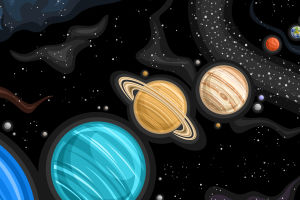
Planet illustrations can create two common misunderstandings. The worlds are frequently drawn much larger than the distances between them, and their orbits may be placed too close together so every planet fits on one page.
The real planets are separated by enormous gaps, particularly in the outer system. Their nearly common orbital plane reflects formation from a rotating disk of material, although each orbit has its own tilt and shape.
Include Smaller Members
A planet is not the standard size for every solar-system body. Recognized dwarf planets include Ceres and Pluto, and numerous moons orbit planets, dwarf planets, and some asteroids. Most asteroids are rocky or metallic, with many located between Mars and Jupiter. Comets contain ice, dust, and rock; when some approach the Sun, heating releases material that can form a bright surrounding cloud and tails.
Meteoroids are smaller pieces moving through space. A meteor is the visible light produced when such material enters an atmosphere, while a meteorite is a piece that reaches the ground. The terms describe related objects or events at different stages, so they are not interchangeable. Studying these smaller bodies helps scientists examine material that remains from the solar system’s early formation.
Separate Nearby Nebulae
A nebula is a large region of gas and dust between stars. Some nebulae are sites where stars form, while others contain material released by aging or exploded stars. The solar system formed about 4.6 billion years ago from part of a collapsing cloud that became a rotating solar nebula. Material gathered at the center to form the Sun, while the surrounding disk produced planets and smaller bodies.
The word “nebula” in that formation account does not mean a visible nebula now surrounds the planets. Present-day nebulae shown beside planets in educational art are normally included to represent the wider universe or the system’s origin.
They may be hundreds or thousands of light-years away. Keeping that distance clear prevents a useful illustration from becoming an inaccurate map of objects located next to one another.
Measure the Outer Reach
Neptune is not the physical edge of the solar system. Beyond it lies the Kuiper Belt, a broad region containing many icy bodies. Much farther out, models predict the Oort Cloud, a vast shell of icy objects that may supply some long-period comets. It has not been directly observed as a complete structure, so its form and extent are inferred from comet paths and mathematical work.
Another boundary, the heliopause, marks where the outward flow of solar particles meets the surrounding interstellar environment. This particle boundary and the distant gravitational reach associated with the Oort Cloud answer different questions, which is why the solar system has no single simple edge. A spacecraft can cross the heliopause while remaining far from leaving the Sun’s wider gravitational domain.
Understanding the solar system requires more than memorizing eight names; it depends on recognizing categories, distances, and the limits of diagrams. Place each object at the correct scale, and distant nebulae, planets, and outer icy regions become distinct parts of a consistent scientific picture.